

Disclosure: This post may contain affiliate links, which means I may earn a small commission at no extra cost to you. I only share products I genuinely love and recommend. This content is also for educational purposes only and is not intended to diagnose, treat, cure, or prevent any illness or disease. Please consult your healthcare provider with any medical concerns or medication questions.
Have you ever finished a challenging workout and woken up the next morning feeling sore, stiff, or more tired than usual?
Because inflammation is often discussed as something to lower or avoid, it is easy to assume that any inflammatory response is bad for your health. But inflammation is not automatically harmful. It is actually one of the ways your body responds when something needs attention.
Your body may create an inflammatory response after physical stress, tissue damage, illness, or another challenge. This response helps begin the process of cleanup, repair, and recovery.
The concern is not simply that inflammation is present. What matters is whether the response is appropriate for the situation and whether your body has sufficient time and support to recover.
In this post, you’ll learn what inflammation is, the role it plays in your body, and what may happen when your total stress load becomes greater than your ability to recover.
👉 Before we get started: Be sure to grab access to my Free Wellness Library. It’s packed with e-books, gut health checklists, food trackers, and practical resources to support your gut health.

What Is Inflammation?
Inflammation is a natural signaling process your body uses when it notices stress, tissue damage, or another challenge.
Your body releases different messengers to coordinate this response. Some are inflammatory proteins called cytokines. Others are fat-derived compounds called eicosanoids.
I find it helpful to think of them as messages that tell your body where attention is needed.
These signals help your body:
- Recognize that tissue has been stressed or damaged
- Begin the repair process
- Clear away damaged cellular material
- Adapt to manageable physical stress
Inflammation is not a mistake your body makes. It serves an important purpose within the repair and recovery process.
Exercise is one of the clearest examples of why inflammation is not always a bad thing.
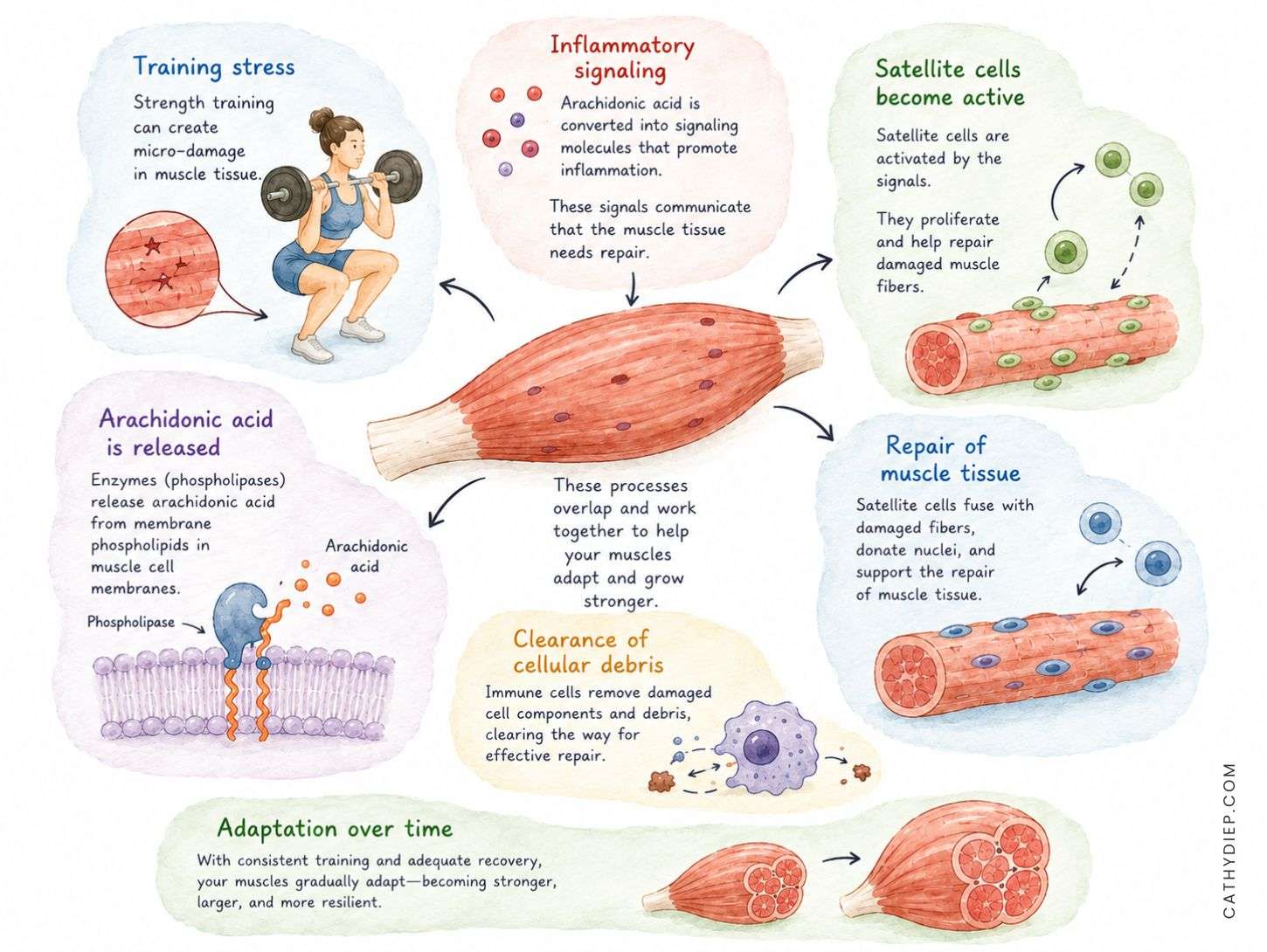
When you strength train, you create small amounts of stress and damage within your muscle tissue. Your body recognizes that the tissue has been challenged and begins sending signals that repair is needed.
As part of this process:
- Muscle cell membranes naturally release arachidonic acid.
- This contributes to inflammatory signaling.
- Those signals communicate that the muscle tissue needs repair.
- Cells involved in muscle repair, known as satellite cells, become active.
- The body begins clearing away cellular debris.
- The muscle can gradually adapt to the training stress.
This is why feeling some soreness after a challenging workout does not automatically mean something has gone wrong. Your body is responding to the activity and beginning the recovery process.
The Amount of Stress Matters
A manageable amount of physical stress can help your body adapt, but too much can make recovery more difficult.
The same workout may affect two people very differently. Someone who has trained consistently may recover comfortably, while someone who is new to exercise may experience much more tissue stress.
Your sleep, nutrition, age, and current stress level also influence how much physical demand your body can manage.
This is why it is more helpful to consider the individual and the situation rather than labeling inflammation as entirely good or bad.
When Can Inflammation Become a Concern?
Inflammation may become less helpful when the demands placed on your body are greater than its ability to recover.
A challenging workout may feel manageable when you are well rested and eating well. That same workout may feel overwhelming when you are already tired or dealing with several other stressors.
Factors that may add to your overall stress load include:
- Exercising harder or more often than you can recover from
- Getting too little sleep
- Managing ongoing emotional stress
- Eating a dietary pattern high in certain omega-6 fats
- Not allowing enough time between demanding workouts
When several of these factors build up, you may feel unusually tired, stiff, sore, or worn down.
The Rain Barrel Effect
One way to picture your total stress load is to imagine a rain barrel.
A difficult workout, a restless night, emotional stress, and an unbalanced diet each add more water.
When the barrel is relatively empty, your body may manage an additional challenge and recover within a reasonable amount of time.
When it is already full, one more demand may cause it to overflow. You may then notice that an activity that normally feels manageable leaves you feeling much more tired or sore.
This comparison helps explain why recovery is about more than the workout itself. It also depends on what else your body is managing at the time.
Why Inflammatory Balance Matters
Your body needs an inflammatory response to support repair and cellular cleanup. However, a response that becomes excessive or continues alongside ongoing stress may affect how you feel and recover.
The appropriate amount of challenge will not look the same for everyone.
For example:
- Someone who exercises regularly may tolerate a demanding workout.
- Someone new to training may need a gentler starting point.
- A well-rested person may recover more comfortably.
- Someone who is already worn down may benefit from reducing the intensity.
A healthy stressor can become too much when it exceeds your current recovery capacity. This is why more exercise, more restriction, or more supplementation is not automatically better.
Temporary Relief Does Not Always Address the Cause
Products that affect inflammatory pathways may temporarily reduce soreness or discomfort.
That relief may have a place in certain situations. However, lowering the signal is not always the same as addressing why it appeared.
For example:
- Reducing soreness does not change an overly demanding exercise routine.
- Temporary relief does not replace restful sleep.
- Lowering discomfort does not correct an unbalanced eating pattern.
- Feeling better does not necessarily mean the original stressor has changed.
Inflammation may be uncomfortable, but it can also be part of your body’s attempt to respond to a challenge.
Everyday Habits That May Influence Inflammation
You do not need to avoid every form of stress. The goal is to choose a level of challenge that your body can respond to and recover from.
Match Exercise to Your Current Capacity
Exercise can be supportive when it matches your current fitness and recovery capacity.
Consider:
- Beginning at a level that feels appropriate for you
- Increasing intensity gradually
- Allowing recovery time between demanding sessions
- Paying attention when soreness or exhaustion lasts longer than expected
- Adjusting your routine when your overall stress is already high
A productive workout should challenge you without consistently leaving you depleted.
Make Room for Sleep and Recovery
Sleep influences how much stress your body can comfortably manage.
A workout may feel manageable after several restful nights. The same activity may feel much harder when you are already tired.
Rather than evaluating exercise, food, sleep, or emotional stress separately, consider how they may be adding up together.
Consider the Fats You Eat Regularly
The fats in your food provide building blocks for different inflammatory pathways.
Both omega-6 and omega-3 fats have a role in the body. Their overall balance matters.
A dietary pattern containing large amounts of certain omega-6-rich oils may contribute to the production of more inflammatory compounds.
Foods that provide omega-3 fats, including fatty fish, support the other side of this balance.
Related:
How to Start an Anti-Inflammatory Diet (Beginner Guide)
Look at the Full Picture
When you feel more tired, sore, or run down than usual, consider asking yourself:
- Have I been sleeping well?
- Has my exercise routine become more demanding?
- Am I managing more stress than usual?
- Have I allowed enough recovery time?
- Are several smaller demands adding up?
The most supportive choice is to adjust your routine and give your body more room to recover.
💢 Want help looking at the bigger picture?
When digestion, energy, stress, sleep, and recovery all seem connected, it can be difficult to know what to focus on first.
As an Integrative Health Practitioner, I help you look more closely at your individual patterns. When appropriate, simple at-home lab testing can provide additional information to help guide a personalized nutrition, supplement, and lifestyle plan.
👉 Learn how private health coaching and functional lab testing can help support you.
Quick Recap
✅ Inflammation is a natural response that helps your body recognize stress and begin making repairs.
✅ A controlled inflammatory response supports cellular cleanup, muscle repair, and adaptation.
✅ Some soreness after exercise does not automatically mean inflammation is harmful.
✅ Inflammation may become a concern when your total stress load exceeds your ability to recover.
✅ Sleep, nutrition, appropriate exercise, and daily stress can all influence your inflammatory balance.
Final Thoughts
Inflammation is often treated like the enemy, but it plays an important role in how your body responds to challenges, begins repairs, and adapts.
A temporary response can be useful. The concern is when demands continue to build without enough time or support for recovery.
Pay attention to the feedback your body gives you. Soreness, stiffness, and fatigue may be signs that it is time to reassess your total stress load and make more room for rest.
Now I’d love to hear from you! Were you surprised to learn that inflammation plays an important role in the body? Let me know in the comments below.
Additional Resources
- How to Reduce Inflammation by Fixing the Root Cause
- How to Start an Anti-Inflammatory Diet (Beginner Guide)
- 30 Anti-Inflammatory Foods Proven to Help You Feel Better
- 15 Warning Signs You’re Low in Omega-3s (and How to Fix It Naturally)
- 31 Easy Anti-Inflammatory Dinner Recipes for Busy, Tired Nights

👉 Like this and want to save it for later? Tap the Pinterest Pin button below. It’s an easy way to keep it on hand when you need it.